събота, 28 март 2009 г.

Ringgit Rises to New Monthly High

The Malaysian ringgit reached its monthly high today on the traders’ speculations that the demand for the emerging markets’ assets will increase as the recession eases.

The emerging stock markets in the Asian region continue to rise and such currencies as the Malaysia’s ringgit and the Korea’s won are posting one of the longest gaining streak in their recent history. The stimuli from and for the world’s leading economies — U.S., Europe and China boost the demand for export and positively influence the attractiveness of risk-associated assets.

There is also a great positive signal from the optimistic expectations for the Group of 20 meeting, which will be held in London on April 2. The analysts expect the Asian currencies to continue their growth next week. Traders will remain in a bullish trend on everything that has been oversold at least until the G20 meeting is over.

USD/MYR declined from 3.6245 to 3.6165 as of 7:18 GMT today. It reached 3.6135 earlier today — it’s lowest level since February 16.

сряда, 18 март 2009 г.

Fed Move Slams USD

The dollar collapsed following the FOMC monetary policy decision in the Wednesday afternoon session. Although the Fed left its benchmark interest rate unchanged at 0%-0.25%, it announced additional measures to prop up the economy and loosen credit to the markets. The statement announced, “To provide greater support to mortgage lending and housing markets, the Committee decided to increase the size of the Fed’s Balance sheet further by purchasing up to an additional $750 billion of agency MBS, totaling $1.25 trillion this year, and to increase its purchases of agency debt this year by up to $100 billion to a total of up to $200 billion”. The Fed also announced the purchase of up to $300 billion of longer-term Treasuries in the next six months.


The surprise move by the Fed was lauded by the US equity markets, sending the Dow Jones higher by over 1.5% and the S&P 500 sharply up by over 2.4%. However, the greenback sold off heavily – tumbling to a fresh two-month low against the euro at 1.3436.


GBP Recovers from Jobs


The pound was initially lower versus the dollar and euro, slipping to 1.3847 and 0.9414, respectively. Dragging the sterling sharply lower was a dismal report on the UK jobs data. The January ILO unemployment rate edged up in line with expectations to 6.5%, versus 6.3% in the previous month. The February claimant count spiked up by 138.4k, bringing jobless claims to 1.39 million – which marked its highest level in 38-years.

Cable continues to teeter just beneath the 1.40-level, with interim support starting at 1.3930, followed by 1.39 and 1.3870. Additional floors will emerge at 1.3860, backed by 1.3840 and 1.38. On the topside, resistance is seen at 1.40, followed by 1.4040 and 1.4070. Subsequent ceilings are eyed at 1.41, followed by 1.4150 and 1.42.

Pound Declines before Employment Report

Great Britain poundThe Great Britain pound declined against the other major currencies today on speculations that the employment report that is scheduled for the release today will show that the situation with labor market is worsening.

Despite the continued gains on the global stock markets and the elevated interest for the high-yielding assets, the pound sterling fell for the first day in five against the Japanese yen and continued its yesterday’s moderate decline against the U.S. dollar and the euro. The market participants expect an increased number of the jobless claims in U.K. from the report that’s released today at 9:30 GMT.

Bank of England Governor Mervyn King said during its late yesterday speech in London that the positive outlook for the consumer price growth may turn the monetary policy back to the bullish trend in the interest rate. Analysts saw this statement as a positive signal for the pound but it looks like the markets aren’t sure about the positive CPI numbers appearing on the horizon soon.

GBP/USD fell from 1.4055 to 1.3966 as of 7:49 GMT today. GBP/JPY went down from 138.73 to 137.66, while EUR/GBP rose from 0.9271 to 0.9305 today.

събота, 14 март 2009 г.

Indian Rupee Approaches Recent Record-Low

The Indian rupee declined against the U.S. dollar today, almost reaching a new record-low level, as the domestic companies converted to dollars in order to pay for the imported goods.

Although, the risk-aversion level is quite moderate in the global markets today, the rupee falls as the Indian economy faces much greater risks among the other emerging countries. The drop in the dollar-denominated exports spurs the growth of the internal demand for dollars over their supply. The falling Indian stocks are also pressing hard on the national currency.

The analysts see the main reason for the rupee’s weakness in the internal demand for the foreign currency. The next problem they point out is the net sale of the Indian equities by the foreign funds, which totaled $1.8 billion this year. As long as this fundamental trend persists the INR won’t be able to offer a consistently growing trend against the U.S. dollar.

USD/INR rose from 51.52 to 51.83 as of 9:16 GMT today after reaching as high as 52.10 during the early Asian trading session. The record-high rate of 52.19 was set by this currency pair on March 3.

USD Falls as Financial Turmoil in U.S. Worsens

U.S. dollarThe U.S. dollar declined today against the other major currencies, after showing a good performance yesterday, as the investors expect that the labor market reports, that are to be released today, will signal a further worsening of the recession in the United States.

The Japanese yen is the only major currency that is rising against the greenback for the second day today. It started to react yesterday after Moody’s rating agency said that it may revise the credit ratings of the three U.S. largest banks. But the greatest pressure on the dollar is provided by the expectations for the nonfarm payrolls to fall by the most since 1949 this February.

More than that, if the nonfarm payrolls report will show the worse than expected decline, the dollar selling may turn into a real rally and continue through the next week. On the other hand, analysts say that if the report comes out not so bad, the today’s decline may get snapped by the dollar soon.

EUR/USD rose from 1.2540 to 1.2698 as of 8:25 GMT today. GBP/USD went up from 1.4121 to 1.4272, while USD/JPY declined from 98.03 to 97.31 today.

Pound Falls on HSBC’s Bad Loans

Great Britain poundThe British pound fell against all major currencies today on the concerns that the United Kingdom’s largest bank will have a disastrous time handling the bad loans of its United States unit.

The U. K. currency declined against the dollar and the euro as both the U.K. FTSE 100 benchmark index and the Japanese Nikkei 225 dropped during the late Asian and early European stock market sessions. The additional government help to the banking system will be needed to keep the financial system afloat in the United Kingdom. HSBC, the Britain’s largest bank, declined by 18 percent today.

The currency analysts link the pound’s weakness directly to the country’s banks and the general stock market indexes. The British government has always been eager to give out the money to their banks and this giveaway policy can’t go without increasing the monetary base, which leads to the currency depreciation.

GBP/USD fell from 1.4126 to 1.3883 as of 11:00 GMT today. EUR/GBP rose from 0.8970 to 0.9065, while GBP/JPY declined from 138.78 to 137.29 today.

Korean Won Rises as Asian Stocks Gain

South Korean wonThe South Korean won rose for the third day against the U.S. dollar today as some Asian stock markets showed the growth and the high-yielding currencies were favored by the traders.

The majority of the most-traded Asian currencies (except the Japanese yen) showed gains today that can be simply regarded as the correctional movement after one of the worst beginnings of the year. The Korean KOSPI composite index advanced by almost 2 percent today as the investors thought that it was largely oversold recently.

Some analysts go as far as stating that the current month will be the final really bad one for the emerging markets and beginning from April the things will be gradually improving for them. The South Korean won trading near 1,500 per dollar looks very promising if you consider a global recovery soon. The currency was just a good buy, which was supported by the growing stocks today.

Until today there were speculations that the Korean foreign exchange reserves aren’t liquid enough to supply the U.S. dollars whenever the demand arises. The Bank of Korea informed the market participants today that the reserves can be turned into cash anytime to satisfy the demand for dollars if required. More than that, the last currency auction was skipped due the diminishing demand for the greenback.

USD/KRW fell from 1537.5 to 1510.6 as of 6:00 GMT today. It was reaching as high as 1559.0 yesterday.

Yen Gains as Chinese Exports Slump

Japanese yenThe yen rose today against the other major currencies on Forex as the China’s exports declined at a record fast pace and the largest Swiss bank reported an increased loss.

According to the China’s customs bureau’s report the country’s trade surplus declined to the lowest level since February 2006; UBS reported $18 billion loss for the year 2008. After that the Japanese yen gained mostly against the U.S. dollar and the New Zealand dollar but earlier during the trading session it was reaching the high levels mainly against the high-yielders.

The uptrend on the dollar/yen pair reached a resistance level near the rate of 100 and failed to break it. The current strength of the yen is derived from that failure. The analysts believe also that the correction in the risk-aversion that was active during the last two-weeks is probably over now and the «safe haven» currencies will continue to rally soon.

USD/JPY went down from 98.69 to 98.49 as of 11:14 GMT today after reaching as low as 98.24 earlier today. EUR/JPY fell from 125.38 to 125.24, while GBP/JPY declined from 135.88 to 135.76 after falling as low as 134.38 today.

Yen Gains vs. Dollar for Third Day

Japanese yenThe Japanese yen rose against the U.S. dollar for the third day in a row today as the global recession boosted the demand for the «safe haven» currencies, decreasing the attractiveness of the high-yielding assets.

The yen also advanced significantly against the euro and the British pound that are vulnerable both to the yen and the dollar during the times of the risk-aversion. The popular high-yielders — Australian and New Zealand dollars — also fell against the Japanese currency after the final Q4 report for 2008 showed that the country’s economy declined at a fastest pace since 1974.

The latest Japanese report on GDP, while being obviously bad for Japan, is even worse for the other countries as it signals that extremely bad conditions will hurt every economy. More than that, this report was also positive for Japanese yen as the revised GDP change was slightly better than expected. Analysts believe that the global economic conditions will continue deteriorating this quarter.

USD/JPY fell from 97.42 to 96.06 as of 9:56 GMT today. EUR/JPY declined from 124.90 to 122.86. GBP/JPY went down from 134.88 to 132.46 today — the fourth bearish day for this currency pair.

New Zealand Dollar Surges to Monthly High

New Zealand dollarThe New Zealand dollar propelled to the monthly high against the U.S. dollar today, rising for the second day, as the stock marked continued to grow globally, improving the appeal of the higher yielding currencies.

The Australian counterpart of the NZD also rose today against the other major currencies but not at such a fast pace as the New Zealand dollar. The commodity price also went up significantly yesterday, increasing the competitiveness of the regional exporting economies. Yesterday the Reserve Bank of New Zealand decreased the official cash rate to the record low 3 percent (from 3.5 percent) and said that the rate reduction pace will slowdown.

The New Zealand currency also rose for a second day against the Japanese yen, reaching the 2-month high against it, as the risk-aversion declined significantly yesterday on the global economic optimism. The kiwi (as the NZD is sometimes called) advanced for the fourth day against the Aussie today.

Some analysts believe that it’s only a temporary correction from the pessimism that ruled the markets during the last several months. Banks’ shares are rising so are the other equities and it’s natural for the investors to dump the low-yielding yen and dollar for the more promising currencies. The short-term outlook for the Australian and New Zealand dollars is bullish.

NZD/USD rose 0.5184 to 0.5241 as of 9:18 GMT today after reaching as high as 0.5266 — the highest level since February 13. NZD/JPY went up from 50.64 to 51.52 with a daily maximum at 51.84 — the highest since January 12. AUD/NZD fell from 1.2555 to 1.2546 with the daily minimum at 1.2499 — the lowest level since February 19.

EUR & CHF: Correlations in Cash and Futures

EUR & CHF: Correlations in Cash and Futures

Currency markets continue to witness the highly negative correlations between the EUR/USD and USD/CHF exchange rates (one goes up, the other nearly always goes down and vice versa). A product of the dollar’s similar rate of change vis-a-vis the euro and the Swiss franc, this relation has continued to hold much before and after the September 11 attacks, when the Swiss franc’s safe haven status was firmly re-established.

More importantly, an almost perfectly inverse relation between the EUR/USD and USD/CHF does not necessarily imply a similar performance of the dollar against the franc and the euro. As we have identified in previous studies, it took the US dollar 37 days to recover all of its losses incurred against the euro after September 11, breaking even on October 19, 2001. But it took the US dollar 103 days to properly recover all of its post September 11 losses against the Swiss franc, starting to gain on December 24, 2001. This suggests that while the dollar’s behavior against both currencies may be similar in direction, it is far from different in magnitude. The differential in magnitude explains the time lag of the dollar’s behavior vs the franc behind that of its performance against the euro.


In each of the past 24 months, the daily correlations have shown a consistently negative fit (lowest at –0.83, highest –0.99). The relation is equally strong for daily correlations on a weekly basis. This means that the other pair almost always reverses the direction in one pair on a given day.


Yet those wishing to capitalize on this correlation on a shorter-term basis, such as an intra-day horizon, the correlation is far less consistent. The chart below shows the correlations of the 2-hour prices between EUR/USD and USD/CHF for January-March 2002. The average correlation is –0.54, a much weaker correlation than that illustrated in the daily performance. This means that a 2-hour time bracket is far too short for the correlation to play out i.e. for one pair to reverse the other pair’s direction. Traders, who aim at hedging their EUR/USD or USD/CHF positions, could open a reverse position in USD/CHF or EUR/USD that can help reduce exposure given at least half a day’s session has elapsed.


Meanwhile, in the futures market, no discernable correlation is found between EUR/USD and USD/CHF speculative futures contracts, as seen by weekly traders’ commitment reports at the International Monetary Market. The charts below show traders’ net euro positions are unrelated to traders’ net Swiss franc positions. Also, the closeness between the spot exchange rate and net future positions varies from one cycle to another. Speculators have been net buyers of euro futures contracts since November of last year, but the euro had mainly floundered from 90 cents to 88 cents. Meanwhile, Swiss franc speculators have predominantly shorted the currency since late December to little avail to the currency.


- April 2, 2002

Yen: Between Repatriation and Depreciation

Yen: Between Repatriation and Depreciation

Japan's much-awaited anti-deflation package--unveiled in the last week of February-- missed the mark as far as markets were concerned. The package involves two phases: The first will contain measures to stabilize stock prices and a call for additional monetary easing from the Bank of Japan. The second phase, postponed until after March 31 (the end of the fiscal year) will tackle the main issue of tax reforms and the elimination of bad debt loans. Injections of public funds into banks will only be implemented in case of severe financial crisis. This begs the question as to what really constitutes crisis in Japanese terms. The whole package is structured to work in coordination between the government and the Bank of Japan. The package consists of two parts instead of one due to Diet's (the Japanese parliament's) current debate of the budget draft for the coming fiscal year and Koizumi's pledge to keep the 30 trillion yen of bond issuance for the present year.

But markets' expectations were so low that the Japanese government didn't disappoint its critics. Even the Bank of Japan's latest decision to further ease monetary policy had very little effect on sentiment. Overall pessimism with Japan's reform inertia is likely to increase rapidly and push the Japanese currency lower over the medium term. The only obstacle has been seasonal repatriation flows, which occur when Japanese investors sell their foreign-based assets and convert the proceeds into yen to boost balance sheets ahead of the end of half-year and full year book closings in September and March respectively.

While repatriation forces could drag the dollar down to the 131.00-50 region, a waning in these operations in late March may pave the way for a resumption in yen outflows. Thus, USD/JPY could target the 138-140 once the 135.00/20 major resistance band is broken.

Repatriation Reversal

Japanese repatriation stands on its head the normal pace of outward investment during the months leading up to the fiscal half year-end in September and fiscal year-end in March. But after these periods, outward investment resumes, putting yen under pressure.

Following the half-year end in September 2001, Japanese net investor flows turned sharply outward in October putting the yen under pressure as it fell from around 119.50 to 123.50 against the dollar. Japanese were large buyers of foreign bonds and equities at this time, totaling 5.5 trillion yen -- The largest increase in over 3 years of outward investment.

Consequently, Japanese net portfolio flows are likely to turn negative again in April given the weakness in Japanese stocks and the risk associated with the Japanese government bond bubble. Reversal of repatriation flows should then propel USD/JPY higher.

THE US DOLLAR: BEFORE AND AFTER THE CRISIS

The US Dollar: Before and After the Crisis

The US dollar has regained all of the losses incurred against the Swiss Franc after September 11. After having lost as much as 5%, it is now nearly unchanged from that day. The charts show, what the US currency did (in percentage terms) 40 days before Sep 11, 20 days before, 10 days and so on. Then, it illustrates what the dollar did the days following the September 11 attacks.

So to illustrate, the chart below shows that the dollar was virtually unchanged 20 days before Sep 11 (-20), compared to the price on Sep 11. But 10 business days after September 11, the dollar lost as much as 5% against the Swiss franc.


SOURCE: FOREXNEWS.COM

But the 3 charts below show that US dollar has more than regained the post September 11 losses it incurred against the euro, yen and pound sterling, and is now above those levels. This suggests that these currencies have poor roles as safe haven currencies vs the dollar, and it's only the Swiss franc that is able to effectively command that role.


SOURCE: FOREXNEWS.COM

On Oct. 22, the yen hit a 10-week low vs the dollar at 122.58, lifting the dollar as high as 2% against the yen from Sep 11.


SOURCE: FOREXNEWS.COM

Pound Sterling is the worst performer against the dollar. It is down nearly 3% against the dollar from Sep 11.


SOURCE: FOREXNEWS.COM

On Oct 22, the dollar Index (trade-weighted average index) soared to 115.98, its highest level since September 4 when it hit 116.03. The highest level before that was in early August when it stood above 117.

NOTE: The 15-year high stands at 121, seen on July 6.

The euro could well find the 87-88 cent level as European think tanks downgrade Euroland's growth forecasts while the ECB continues to fall behind the curve in stimulating growth. The Dollar Index could soon hit 117, which could translate to 87-88 cents in the EUR/USD exchange rate and 123-124 in the USD/JPY exchange rate.

Global Equities in Tandem

1990-1995 DIVERSIFICATION WORKED

Global diversification proved effective in international portfolio investing due to:
Disparity in growth rates among major economies;
Brunt of world recession;
Relative inefficiencies in international portfolio investments (Emerging Markets Hysteria had yet to unfold)

* Fed raised rates 6 times for a total of 250 bps (Feb, Mar, Apr, May, Aug, Nov)
** The Peso Crisis and the Uprising in Chiapas
*** Capital Exodus from Mexico heightened triggered overall loss of confidence in Emerging Markets. This was compounded by the collapse of Barings Bank
GDP growth in industrialized nations: 1992= 2.1%, 1993= 1.4%, 1994= 3.3%, 1995=2.7%


1994-1996 TRANSITIONS

Broadening global recovery, US bail-out of Mexico, and the US entry into the "New Economy" paradigm all led to improved global market sentiment, which brought markets more in line.

GDP growth in industrialized nations: 1995= 2.7%, 1996= 3.2%

1997-2000 UNIFORMITY

As world economies begin to sustain their recoveries and cross-border protfolio flows accelerate, global stock markets move in tandem, making global diversification harder to achieve, simply based on geographical plays.

GDP growth in industrialized nations: 1997= 3.4%, 1998= 2.4%, 1999= 3.2% 2000 Forecast = 4.2%

Asia: Asian turmoil reverberates in global markets, one week after Hong Kong's stock market sufferred its biggest drop ever, losing nearly 25% in 4 days on uncertainty regarding the HKDollar.

Russia: Russia gets partial debt moratorium on foreign debt. Trading in Russian Rouble is suspended after Russian Gvt. Abandons setting a a floor value for the currency of 7.13 to the dollar, implementing a new floor of 9.5 to the dollar.

Brazil: Despite $41 bln IMF loan package to Brazil in Nov, the Lat Am nation devalues its currency after Head of regional State refuses to repay State debt.

January Tech Sell-off: Tech stocks get a beating on overvaluation worries, exacerbated by investors' unloading of stocks after New year to avoid capital gains tax.

JPY Extends Losses

The yen continued to plunge against the greenback, dropping to its lowest level in 3-months at 98.60. The Japanese currency’s role as a safe-haven has lost its luster in recent weeks following the break of the key 92.75-level, sharply weakening in tandem with the latest round of weak economic reports from Japan.

Although the yen has recovered from some of its earlier losses, we anticipate further weakness in the currency over the coming weeks with our initial target seen at 99-figure. However, we look for the 100-level to cap additional moves higher in the USDJPY pair and expect a combination of repatriation prior to the end of the Japanese fiscal year and a return to its role as safe haven currency to benefit the yen.

USD Jumps Higher as Safe Haven Currency

The greenback extended its gains versus the yen in the Friday session, while also edging higher against the euro and sterling. Dismal US data and renewed fears of bank nationalization prompted safe haven flows into the dollar.

Economic reports released earlier in the session pointed to a deepening US recession, with Q4 GDP posting an annualized 6.2% contraction – its steepest decline since 1982. The growth figures were considerably worse than both expectations at -5.4% and -3.8% previously. The Q4 PCE prices declined by 5.0% from a 5.5% decline in the prior reading while GDP sales fell by 6.4%, larger than calls for a 5.9% decline versus a 5.1% drop previously. Chicago PMI unexpectedly improved in February rising to 34.2 versus forecasts for a decline to 33.0 from 33.3 in January. The final reading for the February University of Michigan consumer sentiment survey improved from the preliminary reading at 49.1 to 50.5, albeit worse than the January report at 57.8

The US equity market recovered somewhat from earlier steep losses following news that the government would convert its preferred shares of Citigroup into common equity to give it up to 36% stake in the bank. News of the partial nationalization sent the Dow Jones sharply lower in the morning, plunging to just above the key 7,000-level at 7,033.62.

Aussie Slides on GDP Contraction

The Australian dollar plunged sharply in early Wednesday trading plummeting by nearly 100-pips from 0.6380 to 0.6283 following dismal growth data. The report revealed an unexpected contraction in Australia’s GDP for the first time in 8-years, posting a 0.5% decline in Q4 versus calls for a 0.2% increase while edging up by 0.3% from the previous year.

The RBA’s Assistant Governor Edey anticipates short-term weakness and deems Australia’s risk of recession as borderline. The Reserve Bank of Australia surprised markets yesterday by leaving interest rates unchanged at 3.25%, with Bank Governor Stevens saying “the Australian economy has not experienced the sort of large contraction seen elsewhere”.

The Aussie recovered somewhat, recuperating above the 0.63-level to 0.6330. Nonetheless, the AUDUSD pair remains under pressure with support starting at 0.63, followed by 0.6270 and 0.6240. Subsequent floors are eyed at 0.62, backed by 0.6170 and 0.6140. Gains will target interim ceilings at 0.6365, followed by 0.64 and 0.6430. Additional gains will encounter additional resistance at 0.6460, backed by 0.65 and 0.6550.

USD Firms in early Asian Trading

The greenback edged higher at the start of the Asian session, rallying sharply against the Aussie initially and pushing the sterling beneath the key 1.40-level. With US equity bourses still mired near its lowest levels in 12-years, risk aversion will continue to benefit the dollar – which has pushed the euro beneath the 1.25-handle.

US economic reports slated for release later today include the February ADP private sector payrolls, which are seen posting a loss of 615k jobs, deteriorating further from the loss of 522k jobs in January and non-manufacturing ISM. Consensus estimates for February non-manufacturing ISM call for a decline to 41.0 from 42.9, remaining mired beneath the key 50-level for its 5th consecutive month.

Traders will closely scrutinize Friday’s key labor report given the weakness in the US jobs market. The unemployment rate in February is expected to spike to 7.9%, a level not seen since 1984 and up sharply from 7.6% from January. The non-farm payrolls figure is estimated to reveal a loss of 600k jobs – its worse level since 1974.

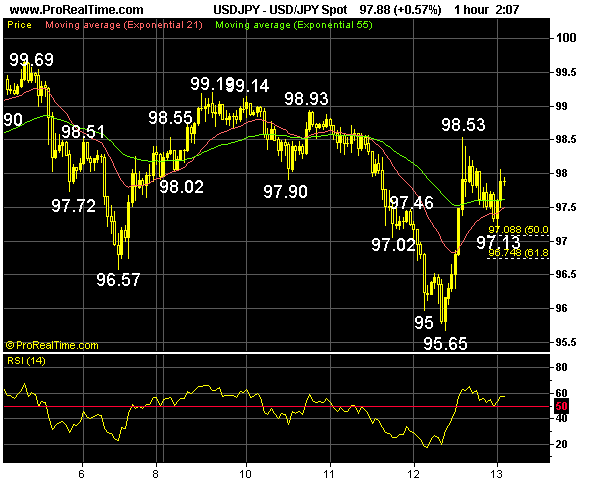
DAILY TECHNICAL OUTLOOK ON USD/JPY

Last Update At 12 Mar 2009 23:26 GMT
Trend Daily ChartDaily Indicators21 HR EMA55 HR EMA
Up Rising 97.42 97.60
Trend Hourly ChartHourly Indicators13 HR RSI14 HR DMI
Sideways Rising 54 +ve
Daily Analysis
Consolidation with mild upside bias
ResistanceSupport
99.69 - 05 Mar high
99.19 - 09 Mar high
98.53 - 12 Mar low
97.02 - 11 Mar low
96.52 - Prev. res
95.65 - 12 Mar low

        USD/JPY - 97.65...Despite y'day's initial selloff to 95.65 (several stops
were triggered), the dlr staged a strg rebound fm there as an option barrier at
95.50 was successfully defended n intra-day rise accelerated in U.S. session on
the back of the strength in U.S. equities n also active cross selling in yen
(eur/jpy rallied fm 122.16 to 126.40), price hit a session high of 98.53 in NY
b4 retreating.
Y'day's cross-inspired rally signals the decline fm 99.69 (March 5 high)
has formed a temporary low at 95.65 n consolidation abv there is seen with mild
upside bias, abv 98.53 wud extend gain twds pivotal res at 99.19 but only a
breach of this lvl wud signal recent upmove fm January's multi-year low at 87.10
has finally resumed, bring re-test of 99.69 n then twds the 'psychological'
100.00 level.
Below 97.02/09 (sup n 50% r of 95.65-98.53) wud yield weakness twd 96.52
(prev. res) but reckon aforesaid low at 95.65 wud hold on 1st testing, bring
further choppy trading...

USD/CAD testing key resistance

EUR/USD failed to move above 1.3050 and is still trapped between 1.33 and 1.25. A decline below 1.2360 would target 1.23, 1.2240. 1.2060. A move above 1.3190 would take the price to 1.33, 1.35.

GBP/USD is still consolidating between 1.50 and 1.35. A move above 1.5230 is necessary for 1.55. A swing below 1.3860 would target 1.37, 1.3550.

USD/JPY reached the important area at 100 and corrected to 96.50. A move above 101.50 would target 102.30. A decline below 95.80 would let the price to slip to 94.00.

USD/CAD reached the key level at 1.300. It corresponds to the resistance of the past five months. A swing over 1.3180 would target 1.3370, eventually 1.35. A breakout failure would take the price back to 1.24.


big size of the diagram


big size of the diagram


big size of the diagram


big size of the diagram

ECB: more cuts ahead?

As expected, the European Central Bank (ECB) cut rates by 50 basis points to 1.50% last week. In the final speech, Mr. Trichet designed a cloudy picture for the Euro zone economy and anticipated more cuts ahead. In fact, ECB expects growth to be on the range of -0.7% to +0.7% in 2010 from -0.5% to +1.5% previously estimated and revised growth for this year from -2.2% to -3.2%. In the fourth quarter of 2008, the Gross Domestic Product (GDP) for the European continent was firm at -1.5% quarter on quarter, while the annual rate was revised to -1.3% from -1.2% previously reported. Exports fell 7.3% and imports slid 5.5%. In Italy alone, GDP is expected to decline below -2.0% this year compared to last year prediction for + 0.4%.

The economic contraction covers all major European countries with Germany experiencing one of the worst recession since World War 2. There are more than 3 million people out of work and consumer spending is shrinking by the minute. Consequently, retail sales fell 0.6% in January from December’s rise of 0.5%. Annually, German sales declined 1.3% after increasing 0.4% in December. The Purchasing Manager’s index (PMI) for the Euro zone service sector slumped to an historical low of 39.2 in February from 42.2 in January. All major European economies registered a loss. The PMI index for Germany declined to 41.3 from 45.2. French PMI slid to 40.2 from 42.6 and Italian PMI moved down to 37.9 from 41.1. More weakness is expected shortly. In France, the ILO unemployment rate printed 8.2% in fourth quarter from 7.6% in the third quarter.

Economic numbers are worsening in the U.S.

The economic picture is deteriorating further in the United States, as unemployment is slumping into record lows and major U.S. industries are still struggling to remain above water. As a result, the Federal Reserve is expected to keep rates near 0 for most of 2009 and beyond, if growth will not pick up tangibly over the coming months. President Obama, in the mean time, outlined, is manifesto for the next fourth years: more taxation for the rich, a new green economy funded by the government, universal education and free healthcare. Obama’s project will mark an end to more than 20 years of Reagan policy, which started right after interest rates topped near 20% in 1980, and continued throughout the Bush administration. Savings should be the mantra for the future with the help of heavy government’s intervention, especially during hard times like the one we are currently experiencing. In February, the unemployment rate was above expectations and rose to 8.1% from 7.6% in January. Employment felt 651,000 on the top of January 655,000 and December 681,000. February’s decline was broadly based with the service production sector slumping 375,000.

The negative data is confirmed by the ISM manufacturing. It rose to 35.8 from 35.6, but stays very weak in most of its components. In effect, new orders fell to 33.1 from 33.2, while employment slid to 26.1 from 29.9, which represents the lowest level ever recorded. The ISM services moved instead down to 41.6 from 42.9. Here, again, most of the sectors are suffering, even though above historical lows. New orders declined to 40.7 and business activity slid to 40.2 from 44.2. Employment, at the contrary, rose to 37.3, though away from the benchmark of 50. In reality, there is not much to rely on at the moment with the exception of a slight improvement in personal spending, which represents 70% of the U.S. GDP. After six consecutive declines, it rose 0.6% in January following a decline of 1.0% in December, while personal income moved up 0.4% from -0.2% in December. However, U.S. construction spending, fell 3.3% in January (-1.5% expected) from -2.4% in December.

SNB Announces Intervention

The Swiss franc sold off sharply against the greenback, hitting its lowest level since December just shy of the 1.20-handle in a knee-jerk reaction to the SNB’s policy announcement earlier in the session. The Swiss National Bank cut its three-month LIBOR target to 0.25%, its lowest on record. The catalyst for the plunge in the Swissie was the subsequent announcement from Bank spokesman Abegg stating the SNB will be implementing intervention in the foreign exchange market -- prompting the Swiss franc’s largest one-day decline against the euro on record.

USDCHF has eased off its 3-month high at 1.1968 to trade beneath the 1.19-level. Support starts at 1.1830, followed by 1.1800 and 1.1750. Subsequent floors are seen at 1.1660, followed by 1.16 and 1.1570. On the topside, resistance begins at 1.19, followed by 1.1930 and 1.1970. Additional gains will target 1.20, backed by 1.2040 and 1.2080.

CHF Plunges on Intervention

The dollar was mixed in the Thursday session, rallying against the Swissie to a 3-month high while slumping versus the euro. US equities maintained a buoyant tone with the Dow Jones edging higher by over 2.5% to recover above the key 7000-level, while the S&P 500 was up by nearly 3% to 743.

Economic reports released earlier saw weekly jobless claims jump to 654k versus 639k from a week earlier. Retail sales in February were better than expected with the headline figure posting a 0.1% decline versus a 1.0% increase in January and the excluding autos reading increasing by 0.7%, down slightly from 0.9% from January. The data slated for release on Friday include January trade deficit, expected to improve $38 billion from a month earlier at $39.93 billion. The University of Michigan consumer sentiment survey in March is seen drifting to 55.0, down from 56.3 while the expectations component is expected to decline to 49.0 versus 50.5 from February.

Foreign Exchange Markets: A Practical Guide

This online guide aims at creating a coherent understanding of the foreign exchange market, by tying in real life market scenarios with the relevant theories of international finance and the classic schools of technical and quantitative analysis. Although there is a vast amount of literature on international finance, technical analysis and chartism, there is a scarcity of instructional materials incorporating actual market events such as interest rate decisions, interventions and geopolitical events.
Another area largely overlooked by currency guides is the integration of fundamental and technical analysis for making decisions. The distinctiveness between the two types of approaches dissuades many from factoring them together. But knowing how to combine them can be highly advantageous in unraveling the trend and timing of currency moves.

This material focuses on teaching how to think for yourself in understanding global currency markets, rather than depending on a pre-set trading system which recommends decisions without providing input on the whys of making right and wrong decisions. Rather than rehashing the classic theories driving currency analysis, this guide will offer investors, researchers and students an innovative approach, paramount in grasping and anticipating the moves in the major currency pairs.

Table of contents is illustrated below

USD Recoups Amid Sharp Stock Advance

The greenback has recovered from some of its earlier sharp losses against the euro, which slumped past the 1.28-level to 1.2822. The primary driver in the foreign exchange market on the Tuesday session was the strong rally in US equity bourses, with the Dow Jones surging by over 4.5%, the Nasdaq advancing by over 6.0% and the S&P 500 gaining by over 5%.

US equities regained their footing after heavy selling in recent sessions on the heels of an internal memo from Citigroup CEO Pandit, describing the current quarter as its best since 2007. Pandit said he was encouraged by the strength of Citigroup’s business in the current year and was profitable for the first two months of the year, adding it was the “best quarter-to-date performance since the third quarter of 2007”.

There was little economic data from the US, seeing only the release of January wholesale inventories and wholesale sales. The January inventories figure declined by 0.7% while the sales number fell by 2.9%. Scheduled for release on Wednesday will be the February Federal Budget, expected to show a deficit of $200 billion, up from $175.56 billion in the previous